An Inconvenient Woman, One Year Later
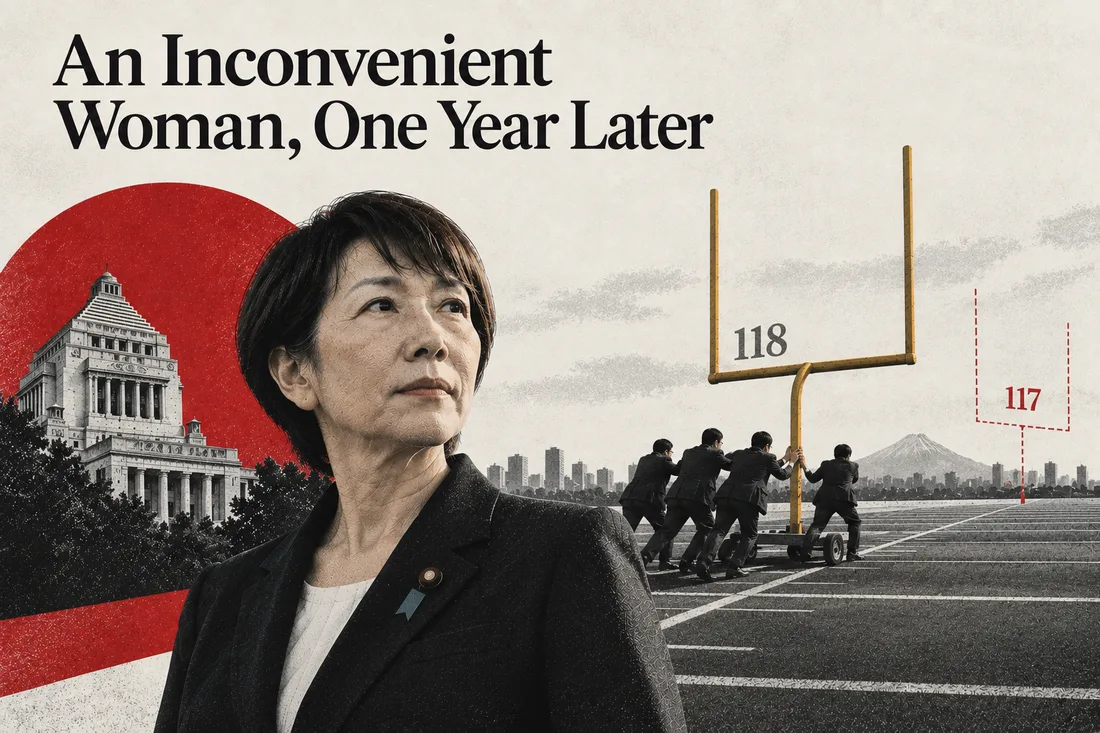
Japan's ranking didn't move. But hey, at least the goalposts did.
Shinji Takeuchi
Previously: An Inconvenient Woman
For years, Japan's failure to produce a female prime minister, among many other things, had been cited as evidence of its dismal record on gender equality. So I assumed that if a woman finally reached the top, Japan would rise substantially in the World Economic Forum's Global Gender Gap Index.
I couldn't have been more wrong.
Japan now has its first female prime minister. And in the 2026 index, it moved from 118th to 117th, just below Togo. A laughable one-place improvement.
Of course, there is a perfectly mechanical explanation for this, as there is for almost everything. One component of the index measures, apparently, how many of the past fifty years a country has been led by a woman.
Japan only started accumulating those years last September. And one female prime minister does not magically change the number of women in parliament, the cabinet, or corporate leadership. Fair enough.
What I find amusing, however, is what happened to the argument around it.
When Takaichi emerged as a serious candidate for prime minister last year, much of the liberal commentary I read suddenly discovered a principle I happen to like very much: gender is irrelevant; what matters is the person, her character, her policies, and what she actually does. The fact that she was a woman, we were told, was no reason to celebrate her.
Again: fair enough.
I therefore half-expected the same people, when confronted with Japan's miserable gender ranking a year later, to say: Who cares? Gender was irrelevant all along. Judge people by what they do.
Strangely, the same liberal media instinctively jumped on the ranking and returned to the familiar sermon: Japan's 117th place is evidence of how far the country remains behind other advanced economies, and how Takaichi is not helping. We are invited, once again, to look abroad and learn—while at the same time joining them in tearing apart Takaichi's character and policies.
And there is an even funnier implication.
If one way for Japan to improve its score is to accumulate more years under a female prime minister, then anyone genuinely concerned about Japan's Global Gender Gap ranking should presumably hope that Takaichi remains prime minister for quite a long time.
I somehow doubt those endorsements are coming. But it would be consistent.
Of course, individual merit and aggregate representation are different things. A female prime minister does not prove that every structural gender disparity has disappeared. But intellectual honesty still requires something.
If representation matters, then an inconvenient woman is still representation. If gender does not matter and only substance does, then perhaps we should be a little more skeptical of rankings built partly around counting the gender of people who occupy positions of power.
You cannot spend years asking, Why has Japan never had a female prime minister?, and when you finally get one, reply, Well, her gender is irrelevant, only to return the next morning to lecturing Japan about its gender gap without at least noticing the rather obvious hypocrisy.
The ranking barely moved. The goalposts did.