Japan’s blind spot in national security — And why that may finally change under Sanae Takaichi
Shinji Takeuchi
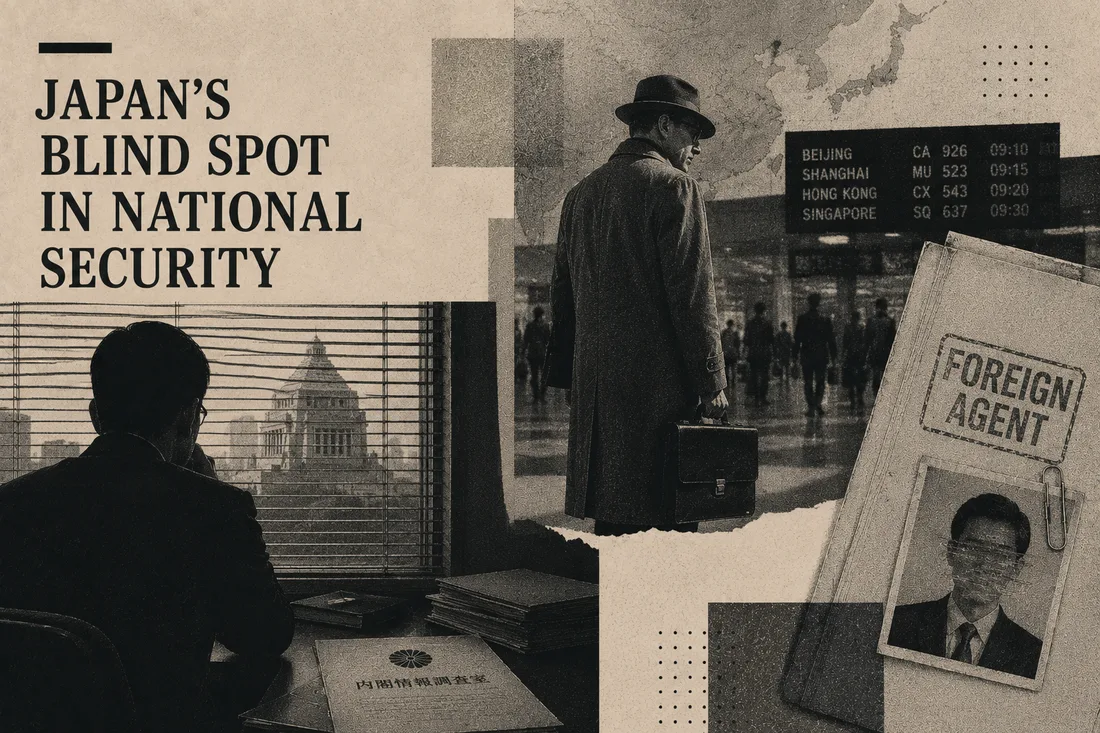
Japan is the only major democracy without a counter espionage law or a formal security clearance system. In a world where foreign intelligence operations are escalating, that gap has become a national liability. With Sanae Takaichi now becoming Japan's prime minister, long delayed reform may finally come into reach.
Takaichi has built her career on national resilience and information security. Her conservatism treats defending democracy and defending secrets as inseparable goals. Whether she can deliver remains to be seen, yet the urgency of the issue can no longer be ignored.
Why Japan is exposed
Japan's vulnerability stems from two interlocking weaknesses.
First, there is no legally-defined framework for personnel vetting. Neither members of parliament nor senior officials undergo systematic background checks before handling classified data. Access to secrets is treated as an automatic right rather than a privilege earned through demonstrated trustworthiness.
Second, espionage is not clearly criminalized. Investigators must rely on minor charges such as unauthorized access or data theft. Proven attempts at infiltration by state sponsored actors are downgraded into bureaucratic misconduct. Foreign intelligence services have exploited these gaps for decades.
These deficiencies force security professionals into evasive workarounds. When concerns arise about political figures or bureaucrats with questionable foreign ties, intelligence officers quietly limit briefings or omit crucial details. Secrecy becomes selective and discretionary. Unelected officials decide who is trusted, without procedural safeguards or transparency.
That is a recipe for both insecurity and abuse.
Japan's allies already draw their own conclusions. The Five Eyes countries are known to have restricted intelligence sharing with Tokyo because Japan cannot guarantee reliable protection of sensitive information. The result is a dual loss: weaker national security and diminished credibility among the partners Japan most needs.
The oversight deficit
Oversight is equally outdated.
Agencies such as the Cabinet Intelligence and Research Office (CIRO, 内閣情報調査室) operate with minimal external scrutiny. The Diet lacks a dedicated body composed of cleared members able to monitor intelligence activity.
All of this has left Japan with a system that hides more than it protects. It is opaque without being effective.
What reform would require
Reversing this situation requires three connected reforms in my view.
First, establish a national security vetting authority that evaluates eligibility for classified access across the government and private contractors. Access would become a defined legal status based on objective criteria such as foreign influence and financial vulnerability.
Second, enact a modern anti-espionage law so foreign agents can be prosecuted for espionage rather than trespassing. Every advanced democracy recognizes espionage as a direct threat to national sovereignty and democratic order. Japan has no reason to exempt itself from that standard.
Third, introduce real oversight that is both strong and fair. Accountability must be built into the system from the start to dispel the false narrative that reform is intended to target political opponents. Critics will of course invoke, as always, memories of the 1925 Public Order Preservation Law (治安維持法). That history deserves respect, but it does not justify permanent paralysis in the face of modern authoritarian interference. Protecting democracy and safeguarding civil rights are not opposing goals; they must advance together.
Designing accountability
The oversight structure should follow a model along the following lines.
Create an Inspector General for intelligence and security, modeled on the U.S. and U.K. frameworks, empowered to audit the CIRO, the Public Security Intelligence Agency (公安調査庁), the Defense Intelligence Headquarters (防衛省情報局), and any new centralized counterintelligence command that the Takaichi administration will no doubt create. Reports must be submitted on a regular basis to a bipartisan but closed parliamentary intelligence committee.
Further, an independent review board should hear appeals from individuals denied clearance or those who believe they were arbitrarily excluded from the process. Redacted decisions and anonymized data on clearance denials should also be published at least annually so that patterns and potential abuses can be identified. Finally, all records should be declassified after a fixed interval, such as twenty years. With these measures, security and accountability should reinforce each other.
The constitutional constraints
Some constitutional issues, however, will remain unresolved.
For example, trials in Japan must be open to the public under Article 82 of the Constitution, and Article 76.2 prohibits the establishment of special courts, which rules out a separate national security tribunal even for espionage cases involving foreign actors. A constitutional amendment has never occurred in postwar Japan and is extremely unlikely in this context, yet the issue deserves a place in the policy debate if Japan does not want foreign agents sitting in the audience observing the full extent of its counterintelligence capabilities in open court.
I do not claim these measures are perfect, but I can say with confidence that anyone serious about defending Japan's constitutional order must be committed to fixing its weakest link in information security. Those who resist any change without offering credible alternatives invite legitimate doubts about their true priorities.
If Takaichi's rise forces Japan to confront this blind spot, the country may finally build the secure, transparent, and accountable intelligence framework that a mature democracy requires.