Everyone Hates Empire. Just Not Their Own.
Shinji Takeuchi
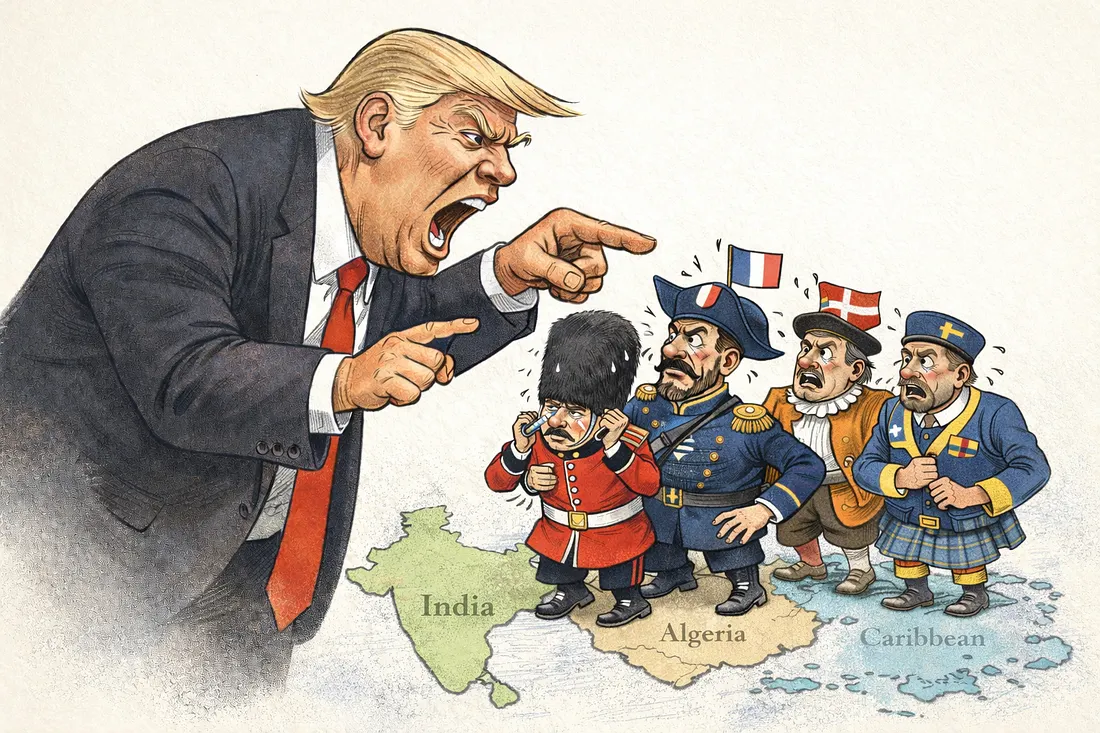
When contemporary debates invoke strategic necessity to justify territorial control, it helps to recognize the script because it is rarely new. The rhetoric now surrounding President Trump's openly stated ambition to acquire Greenland follows that familiar pattern almost line for line.
Greenland is portrayed as occupying a location too strategically important to the United States to be left alone. Its economic potential, including rare earth resources, is described as underdeveloped and its assets as wasted. Left in the wrong hands, these assets are said to threaten not only the United States but the broader regional order. At the same time, Greenland's administration is cast as weak and inadequate, such that its sovereignty under the Kingdom of Denmark is treated as insufficient and in need of replacement by a more competent guardian.
From there, acquisition is recast not as conquest, but as management.
The Same Argument, Made by Europe
All this should sound disturbingly familiar to Europe, because this very logic has been deployed repeatedly by Europe itself over centuries of imperial expansion, whether justified by security, commerce, or some combination of the two.
For the British Empire, the pattern is almost canonical. Gibraltar, Singapore, the Cape Colony, the Suez Canal, Malta, and Cyprus were justified as strategic necessities, as were countless islands across the Caribbean, the Atlantic, the Indian Ocean (including, of course, Chagos Islands), and the Pacific. These territories were not acquired for population or prosperity, but because their locations were considered too important to leave under another power's control. They were strategic choke points that made Britain's global reach possible, much as the Panama Canal, Canada, or Greenland function for the United States.
The French Empire followed the same logic, if often with different legal forms. Algeria offers a close parallel. The conquest of Algeria in 1830 was justified not as territorial ambition, but as a security operation to protect Mediterranean trade and suppress Barbary piracy. Ottoman sovereignty was acknowledged, but Algeria's position in the western Mediterranean was deemed too strategically important to remain under what France characterized as inadequate control. The same reasoning later applied to Madagascar and Djibouti, both acquired as strategic assets to secure France's broader imperial interests, particularly in French Indochina.
The Dutch Cape Colony followed a similarly asset driven logic. The Cape was valued less as a society than as infrastructure, a strategic refueling and control point on global maritime routes. Local sovereignty was treated as irrelevant to the larger demands of trade and security. Control was justified as logistical necessity to sustain Dutch rule in the East Indies.
The Smaller Empires
Nor were the smaller European powers exempt, a reminder that scale did not alter logic.
Denmark maintained colonial possessions in India for nearly two centuries under the banner of protecting commerce and merchants. In the Caribbean, it controlled what later became the US Virgin Islands until the early 20th century, participating in slave trade and slave based plantation economies along the way.
Sweden's colonial experiment was shorter, but no more innocent. The infamous Saint Barthélemy, acquired in 1784, was administered as a free port and integrated into the Atlantic economy. Enslaved people were registered and traded under Swedish colonial law.
The Common Thread
Across all these cases, the common thread is not geography or scale, but argument.
Strategic indispensability becomes moral imperative. Superior administration becomes legitimacy. Backed by superior military capabilities, any opposition, however morally sound or grounded in international law, is rendered futile, dismissed as either minor local opposition or, more often, as rebellion by local leaders deemed incapable of understanding modern governance.
Seen in this light, Greenland is not an anomaly at all. It is a familiar imperial logic repackaged in the language of national security and resource management, made jarring only by its blunt, Trumpian delivery.
The Reckoning That Never Came
Yes, European colonialism occurred long ago. Yes, World War II reshaped international law and the norms of sovereignty and self-determination. And yes, empire became unfashionable, at least rhetorically, as Europe underwent a remarkable transformation from imperial powers once accused of brutal exploitation into self-appointed enforcers of a "rules-based order," all without any serious reckoning with how fundamentally flawed that logic has always been.
That failure now appears to be coming back to haunt them.
Outrage on the Receiving End
In the face of Trump's Greenland ambitions, European leaders now portray the U.S. President's coercion as a uniquely barbaric form of aggression, a return to an era of "might makes right," casting Europe as an innocent victim of American imperialism.
What we have not heard, however, are apologies from most former European empires, including Denmark and Sweden, whose own expansion was justified in the name of security, economic necessity, and superior administration, the very same logic now being invoked by President Trump.
It is rather rich to condemn outright aggression only after discovering what it feels like to be on the receiving end of it.
What has changed is not the logic, but the tone and the speaker.
Imperial reasoning becomes intolerable only when you are no longer the one deploying it.