The Convenient Fiction of Japan’s “Ongoing Debate” on Constitutional Revision
Shinji Takeuchi
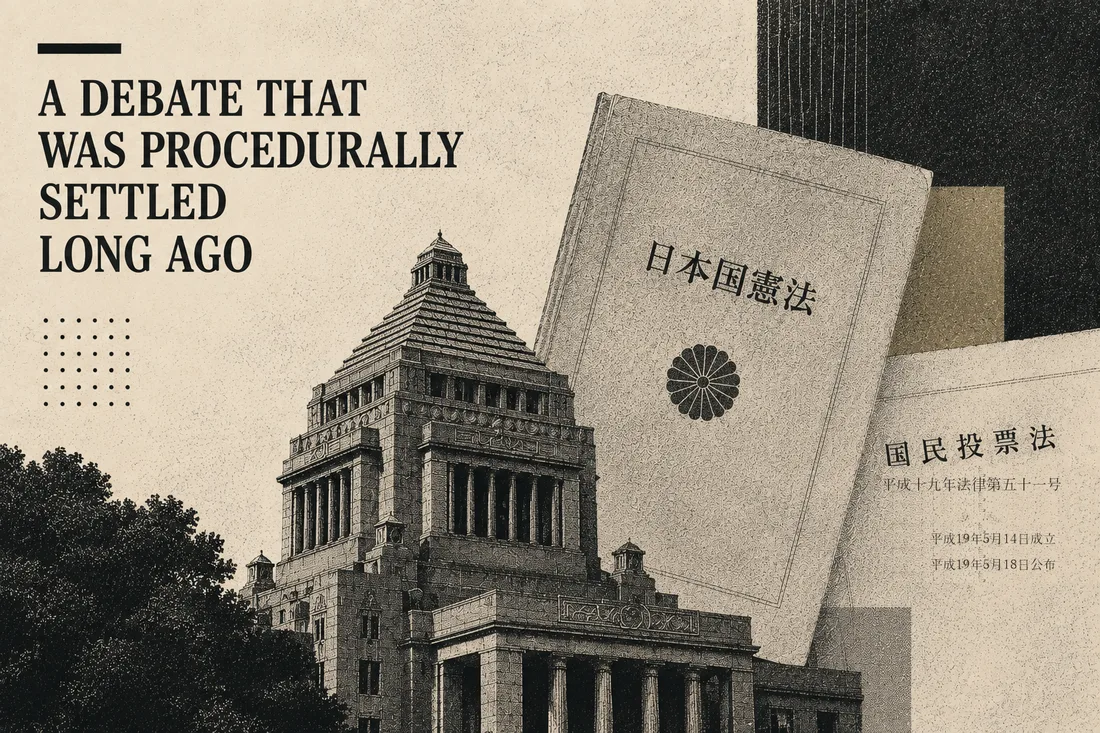
A Debate That Was Procedurally Settled Long Ago
The persistent framing, particularly within legacy media, that Japan is somehow still "approaching" or "considering" constitutional revision reflects not a serious engagement with political reality, but rather a convenient fiction that allows commentators to avoid confronting a far more uncomfortable truth about the state of Japanese democracy.
To begin with, the procedural question has long since been resolved, and to suggest otherwise betrays either ignorance or deliberate obfuscation.
The National Referendum Law, enacted in 2007 under the first administration of Shinzo Abe, established in clear and operational terms the mechanism by which constitutional amendments are to be pursued, thereby giving full legal effect to Article 96 of the Japanese Constitution and eliminating any ambiguity as to how such revisions are to be initiated and ratified. In other words, for nearly two decades, Japan has possessed not merely the theoretical capacity, but the fully institutionalized means to amend its Constitution.
Repeated Electoral Mandates, Ignored
What followed this legislative milestone only further undermines the notion that constitutional revision remains an unsettled or hypothetical issue.
Over the course of multiple general elections, the Liberal Democratic Party and its coalition partners secured repeated victories, often under platforms that explicitly referenced constitutional revision as a core policy objective, and in several instances achieved or came close to achieving the two-thirds supermajority required to initiate the amendment process in the Diet.
These were not ambiguous mandates inferred after the fact; they were explicit political signals, presented to and endorsed by the electorate in full view of the public.
And yet, despite this alignment of legal readiness and electoral validation, the formal amendment process has never been meaningfully activated.
The People Have Spoken, and Been Ignored
It is here that the standard narrative begins to collapse under its own weight, because the absence of progress cannot plausibly be attributed to institutional constraints, procedural uncertainty, or a lack of democratic legitimacy.
Rather, what remains — stripped of the rhetorical insulation provided by media framing — is a persistent unwillingness on the part of the political class to act on a mandate it has repeatedly sought and obtained.
More recently, the political landscape has evolved in a manner that makes continued inaction even more difficult to justify, as figures such as Sanae Takaichi have secured strong and highly visible support within the ruling party, reinforcing the presence of a clearly defined pro-revision bloc with both the ideological clarity and institutional positioning to initiate the amendment process should it choose to do so.
Under such circumstances, the oft-repeated suggestion that Japan is somehow "not ready" begins to sound less like analysis and more like deflection, particularly when one considers that the ultimate decision does not rest with politicians at all, but with the public itself through a national referendum that has already been fully legalized and operationally defined.
The Referendum That Never Seems to Come
Indeed, if constitutional revision is truly as contentious or "hawkish" as critics frequently claim, then the appropriate response within a functioning democratic system is not indefinite delay, but precisely the opposite: to allow the electorate to render its judgment directly.
The referendum mechanism exists for this exact purpose, offering the Japanese people a clear and final opportunity to either endorse or reject the proposed changes, and it is therefore difficult to construct a principled objection to its use that does not, at some level, imply a lack of confidence in the very electorate whose will is so often invoked.
Democracy Without Execution
This is not a case of democratic deliberation unfolding gradually over time; it is a case of political actors retreating from the very outcomes they have campaigned to achieve, leaving in place a system in which electoral victories function less as instruments of policy implementation than as symbolic exercises devoid of consequential follow-through.
For those voters who have consistently supported constitutional revision, the implication is stark. Participation in the democratic process, even when it produces clear and repeated victories, is rendered effectively meaningless when it conflicts with the preferences of the legacy media, and even the existence of clearly defined legal procedures offers no assurance that they will be invoked when the conditions have been fully satisfied.
Conclusion: A Question No One Wants to Ask
One may continue, if one wishes, to describe this situation as an "ongoing debate," but such language increasingly resembles a form of intellectual evasion rather than analysis.
The debate, in any meaningful procedural sense, was settled decades ago; what persists today is not uncertainty over whether constitutional revision can be pursued, but a sustained reluctance to pursue it despite possessing both the authority and the opportunity.
In that sense, the more pertinent question is no longer whether Japan will amend its Constitution, but whether its political system retains the capacity or the willingness to act upon decisions that have, by any reasonable standard, already been made.
With the arrival of Sanae Takaichi, and the decisive electoral mandate that restores a governing majority capable of initiating the amendment process, the era of procedural excuses may finally come to an end.
To oppose moving forward under these conditions, despite decades of electoral victories and the explicit safeguard of a national referendum, is increasingly difficult to interpret as good faith political disagreement. It instead suggests an unwillingness to allow the democratic process to reach a conclusion simply because that conclusion may not align with one's own preferences.